
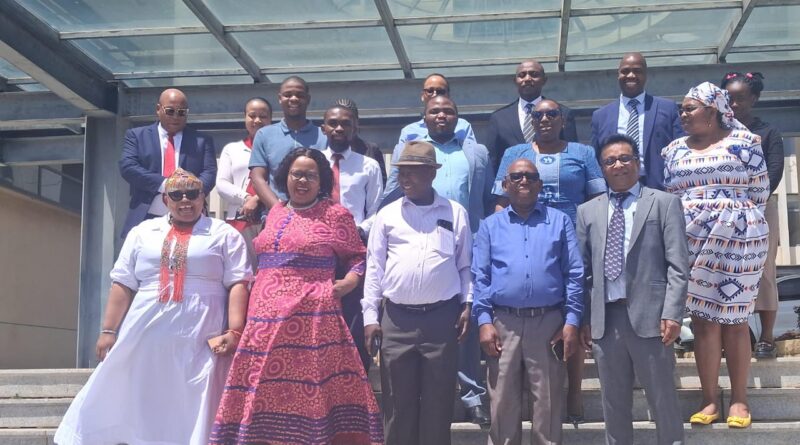
Parly urged to turn SADC SRHR commitmentsinto tangible change
MASERU – Parliament has been challenged to move beyond
rubber-stamping regional pledges and to use its full legislative,
budgetary and oversight powers to ensure that commitments on
sexual and reproductive health and rights (SRHR) translate into
measurable improvements in the lives of ordinary Basotho.
The call came as lawmakers, regional parliamentary officials and
development partners gathered in Maseru for a high-level
parliamentary engagement on accelerating the implementation,
monitoring and accountability of the Southern African
Development Community (SADC) SRHR Strategy 2019-2030.
The three-day meeting, held from Tuesday to Thursday last
week, sought to bridge the persistent gap between the promises
made in regional forums and the lived realities of communities
across the country.
At the heart of the engagement was a blunt message from
Itumeleng Rantsho, Chairperson of the Sustainable
Development Goals (SDGs) in Lesotho – policies and strategies
on paper are worthless unless they are backed by effective
implementation, adequate financing, rigorous monitoring and
genuine accountability for results.
“As we approach 2030, it is increasingly important that we move
beyond making commitments towards demonstrating
measurable progress,” Rantsho told participants. Her remarks
set the tone for a gathering designed not merely to share
information, but to critically interrogate what has been achieved,
what remains outstanding and what is holding back the
realisation of SRHR for all.
A regional blueprint in search of national traction
The SADC SRHR Strategy 2019-2030 was developed as a
ground-breaking regional framework to fast-track healthy sexual
and reproductive lives across Southern Africa, where rights are
protected and realised. It provides a common policy and
programming reference point for all fifteen SADC member
states, aligning regional efforts with global, continental and
regional development agendas, including the Sustainable
Development Goals and the African Union’s Agenda 2063.
The strategy was crafted through an extensive consultative
process involving ministries of health, education, gender and
youth, alongside UN agencies, civil society and youth-led
organisations, and was accompanied by a scorecard to measure
progress.
Yet the existence of a regional blueprint has never been the
problem. The challenge, as Rantsho made clear, lies in the
translation of that blueprint into national laws, policies,
programmes and budgets – and in the willingness of parliaments
to hold governments to account when implementation stalls.
The SADC SRHR Scorecard, a peer-review accountability tool,
has been incorporated into national reporting tools by several
member states, including Lesotho, but its effectiveness depends
on the political will to use it as a driver of change rather than a
box-ticking exercise.
Lesotho’s mixed record: Progress amid persistent gaps
Lesotho’s own SRHR journey offers both encouraging signs and
sobering reminders of the distance still to travel. The country
has reduced maternal mortality by 54 per cent since 2009,
expanded skilled birth attendance to 89 percent and
implemented a national Maternal and Newborn Health
Acceleration Plan aligned with global goals.
Programmes such as the M-Mama emergency transport system
have saved lives in remote mountain communities, and Lesotho
has been recognised internationally for expanding women’s
access to contraceptive self-care, receiving a Life-Saver Award
for its efforts. The unmet need for family planning has dropped
dramatically from 31 percent to 12.6 percent over two decades –
one of the fastest declines on the African continent.
Lesotho has also taken steps to institutionalise comprehensive
sexuality education, with the Lesotho College of Education
training lecturers to deliver CSE in both in-service and pre-
service teacher programmes, addressing teenage pregnancy, child
marriage and HIV prevention at their source.
A new Prevention and Management of Learner Pregnancy
Policy ensures that pregnant learners can remain in school and
return after childbirth, while new referral systems connect
schools to health and social services. The country submitted its
long-overdue CEDAW report in 2024 and has moved to revise
reservations on laws relating to marriage, inheritance and
protection from violence.
But the picture is far from uniformly positive. Lesotho
continues to record one of the highest maternal mortality ratios
in the SADC region, with estimates ranging from 530 to 618
deaths per 100 000 live births. Neonatal mortality remains
stubbornly high at 34 deaths per 1 000 live births, and while
formal commitments to universal access to SRH services and
information exist, there are no standalone laws that explicitly
guarantee enforceable rights to access SRH care, information
and education.
These are not abstract statistics; they represent women and girls
whose rights remain unrealised and whose access to quality care
is constrained by structural, financial and legal barriers.
Lesotho has aligned its national planning with the SDGs,
revising its National Health Policy and developing a Health
Sector Strategic Plan 2026-2030 to ensure alignment with
Universal Health Coverage and SDG priorities. In 2025, the
country presented its Voluntary National Review at the High-
Level Political Forum, highlighting advances and persistent gaps
under SDG 5 on gender equality, including gender-based
violence prevalence, women’s participation in decision-making
and access to services.
A ground-breaking SRHR investment case, validated in 2025,
has for the first time assigned a value to what has long been
immeasurable, providing a data-driven roadmap for accelerating
progress toward national and global health goals. Lesotho has
also emerged as a regional convener on gender-based violence,
hosting a Southern Africa strategic dialogue involving six
countries.
Parliament as the missing link
It is against this backdrop of uneven progress that the Maseru
engagement placed Parliament squarely at the centre of
accountability. Rantsho reminded lawmakers that their
legislative, budgetary and oversight responsibilities are not
ceremonial functions but critical tools for ensuring that regional
commitments are domesticated into national frameworks.
Through these mandates, parliamentarians can scrutinise
government expenditure, question ministries about
implementation progress and demand accountability where
commitments are not being fulfilled.
Parliamentary committees, she stressed, have a particular role in
identifying implementation gaps, engaging government
departments and recommending practical interventions.
The engagement was not intended to be a talk shop. Participants
were expected to work towards developing a Parliamentary
SRHR Oversight and Accountability Action Plan with defined
responsibilities, indicators and timelines.
Rantsho made clear that the success of the gathering would be
judged not by the number of presentations delivered or
discussions held, but by the actions taken afterwards and their
contribution to improving accountability and access to quality
SRHR, HIV and gender-based violence prevention and response
services.
The regional dimension of the work was underscored by
‘Mammehela Matamane, SRHR Officer at the SADC
Parliamentary Forum, who explained that the engagement aimed
to strengthen the capacity of Members of Parliament and key
stakeholders to understand, monitor and hold governments
accountable for implementing the SADC SRHR Strategy and
related commitments.
The meeting also sought to equip lawmakers with practical tools
to assess implementation progress, identify gaps and strengthen
parliamentary oversight of SRHR, HIV and GBV programmes.
Participants were expected to consider the SADC SRHR
Strategy alongside the Minimum Standards for the Integration
of HIV, SRHR and Gender-Based Violence in the SADC
Region, decisions from the February SADC Ministers of
Health/HIV meeting, and the roadmap for accelerating
implementation, monitoring and reporting.
The SADC Parliamentary Forum has been steadily deepening its
engagement with the Parliament of Lesotho.
In February, the parliament convened a capacity-building
workshop with the SADC-PF and the Inter-Parliamentary
Union to strengthen parliamentary scrutiny of laws, budgets and
policies at the intersection of climate change and SRHR. The
Forum’s SRHR, HIV and Aids Governance Project, funded by
Sweden, has worked to institutionalise SRHR within the
structures and work-plans of parliaments, including through
dedicated committees, motions, debates and budget oversight,
ensuring that SRHR is not treated as a stand-alone issue but as a
cross-cutting development priority.
The presence of Mahendrasing Khooblall, SADC-PF Project
Accountant from Namibia, at the Maseru engagement signalled
the Forum’s satisfaction with the progress being made and its
commitment to continued partnership.
From commitments to consequences
The Maseru engagement ultimately posed a simple but
uncomfortable question: what happens when commitments are
not met?
The answer, as Rantsho and Matamane made clear, must involve
parliaments exercising their oversight authority with consistency
and courage. Regional strategies and scorecards have their place,
but they cannot substitute for the mundane, painstaking work of
legislative scrutiny, budget analysis and constituent
accountability.
Lesotho stands at a crossroads. It has demonstrated that
progress is possible – in maternal health, in family planning, in
girls’ education and in regional leadership on gender-based
violence. But it also carries one of the region’s heaviest burdens
of maternal and neonatal mortality, and its legal framework still
lacks enforceable guarantees for SRHR access.
The Action Plan that emerges from this engagement will be
judged by whether it closes that gap.
As Rantsho urged, parliamentarians and stakeholders must
strengthen the link between regional commitments and national
action to advance the health, rights and dignity of the people
they represent.
In a country where a woman’s survival in childbirth can still
depend on whether an emergency transport programme reaches
her in time, the distance between a SADC strategy document
and a parliamentary oversight question is not an abstraction. It is
a matter of life and death – and it is now squarely in the hands of
Lesotho’s lawmakers.
LIAPENG RALIENGOANE