
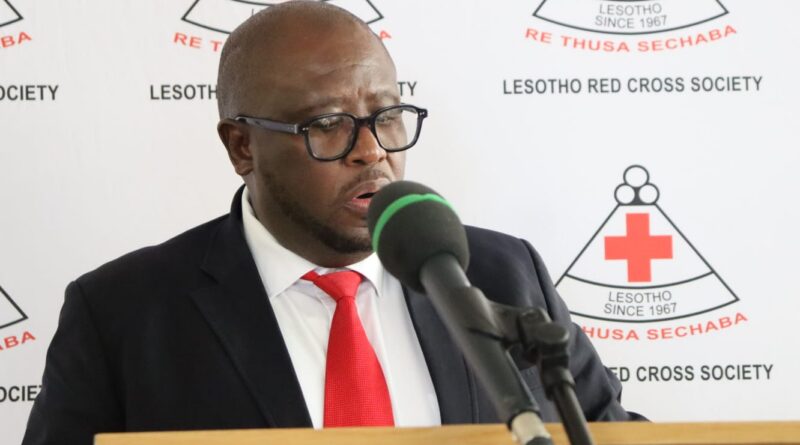
Lesenya Unveiled as New Red Cross President
MASERU – The Lesotho Red Cross Society (LRCS) on Wednesday unveiled Tšeliso Steven Lesenya as its new president during an event held in Maseru, ushering in a new leadership era.
LRCS Secretary General Sechaba Mokhameleli said the election was facilitated on Saturday 29 August during the society’s Annual General Meeting (AGM) and he succeeds Hareteke Nkhetše.
Mokhameleli added that the appointment comes as the Red Cross seeks to reposition itself to respond to an increasingly complex humanitarian environment characterised by climate change, drought, floods, water insecurity, public-health emergencies and economic vulnerability.
He further presented Lesenya’s biography Lesenya’s biography by highlighting his more than two decades of experience in public-sector leadership, governance, international relations, humanitarian affairs and institutional development.
His career has included public-sector reform, digitisation, organisational restructuring and disaster-response coordination, as well as engagement with international development partners including the World Bank, UNDP, European Union and Commonwealth.
He is also a National Governance Expert to the African Peer Review Mechanism of the African Union and National Coordinator and International Relations Specialist for the Small States Research Programme at the University of Westminster.
Lesenya is a Chevening Scholar and holds a Master’s degree in International Relations and Democratic Politics from the University of Westminster, awarded with Merit.
While presenting his vision for LRCS, the new president Tšeliso Lesenya said the Society’s National Executive Committee has adopted a Presidential Four-Year Transformation Agenda for 2026–2030, under the theme “Renew. Reposition. Resilience. Results.”
The agenda seeks to build a Red Cross that can anticipate humanitarian risks, prepare communities and act early, rather than relying solely on response after disasters occur.
Among the proposed initiatives is the establishment of a National Crisis and Rapid Response Coordination Centre, which would strengthen emergency coordination and rapid mobilisation while improving volunteer, medical and logistical capacity.
Climate resilience and water security are also prominent in the new vision. Through Water for Life Lesotho, the Society plans to explore practical approaches to humanitarian water security, particularly for vulnerable communities and health facilities affected by drought and climate-related emergencies.
It also intends to explore humanitarian water diplomacy, using its humanitarian mandate, community presence and partnerships to promote preparedness and protection for communities affected by water-related emergencies.
The new leadership also announced that the Society plans to explore the feasibility of establishing a Southern Africa Regional Humanitarian Emergency and Pandemic Response Centre in Lesotho, which could support emergency coordination, humanitarian logistics, training, simulation, research and surge capacity. The proposal remains subject to feasibility assessment and consultation with relevant institutions.
Financial sustainability will form another pillar of the transformation. The Society intends to review its property and other assets with the objective of turning underutilised resources into sustainable income and greater humanitarian capacity. Proposed areas include property development, humanitarian hubs, training and conference facilities, warehousing and strategic partnerships.
The transformation agenda further prioritises the Society’s 10 district structures, volunteers and youth, with an emphasis on training, digital systems, local resource mobilisation and community-based preparedness.
Lesenya brings substantial experience to the presidency. He currently serves as Deputy Principal Secretary in the Office of the Prime Minister and has previously served as a Principal Secretary and Chief Accounting Officer.
LRCS was established on 09 November 1967 as voluntary aid auxiliary to health authorities and it renders best practices in humanitarian services. The patrons of LRCS are His Majesty King Letsie III and Her Majesty Queen ‘Masenate Seeiso.