
Young women know their rights, but society won’t let them use them, new evidence shows
MASERU — Adolescent girls and young women in Lesotho possess a strong internal foundation of confidence and capability when it comes to their sexual and reproductive health.
Yet a new assessment presented to parliamentarians this week reveals that this personal strength is being systematically undermined by social expectations, community judgment, and unequal relationships – barriers that prevent them from translating what they know into the decisions they are entitled to make.
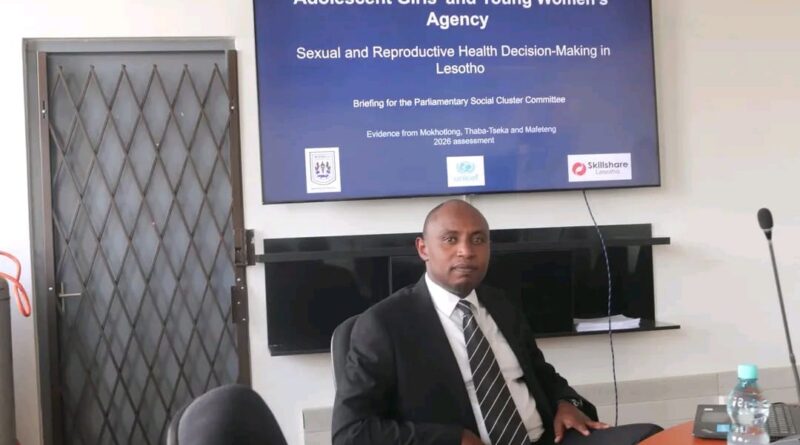
Skillshare Lesotho, a local organisation working to advance the agency of young people, presented findings from its 2026 assessment on adolescent girls’ and young women’s (AGYW) agency in sexual and reproductive health and rights (SRHR) decision-making during a parliamentary engagement convened by the Southern African Development Community Parliamentary Forum (SADC-PF).
The three-day session, held from Tuesday to Thursday, sought to strengthen parliamentary capacity to accelerate the implementation, monitoring, and accountability of the SADC SRHR Strategy 2019-2030.
The evidence, drawn from 626 respondents across Mokhotlong, Thaba-Tseka, and Mafeteng districts, paints a nuanced picture. AGYW in these districts are not lacking in knowledge or self-belief.
The overall agency score measured by the assessment was 24.6 out of a possible 32, with respondents scoring 8.61 out of 12 on decision-making autonomy and 15.45 out of 20 on self-efficacy and confidence. The results suggest that the raw material for independent decision-making is present.
What is missing is an environment that permits it.
According to the findings, 44.3 percent of respondents reported expectations that girls must seek permission before accessing healthcare, while 39.6 percent reported community judgment directed at girls who seek contraception.
Qualitative evidence further revealed that contraceptive decisions are heavily influenced by partners, household authorities, and community expectations, with some young women resorting to secrecy around their contraceptive use due to fears of disclosure. In other words, the gap is not one of information or personal resolve, but of permission – both granted and withheld by the people and structures surrounding young women.
These findings land in a country where the broader SRHR indicators for AGYW remain deeply concerning. Lesotho’s adolescent birth rate stands at 95 births per 1 000 girls aged 15–19, more than double the global average of 44. Seventeen percent of women aged 15–19 have had at least one pregnancy, and in some districts the situation is worsening.
In Qacha’s Nek, one-third of all pregnancies recorded between January and June 2025 occurred among girls aged 13 to 19. In Mohale’s Hoek, health authorities reported that one in every four girls fell pregnant during the first six months of 2026, up from one in five the previous year.
HIV disproportionately affects young women as well. While HIV prevalence among adolescent girls aged 15 to 19 stands at 3.9 percent, it rises sharply to 13 per cent among young women aged 20 to 24, compared with 2.4 percent among males in the same age bracket.
Only 30.7 percent of AGYW displayed comprehensive knowledge of HIV transmission and prevention in a 2016-2017 survey. These figures are not abstract; they reflect a generation of young women navigating profound health risks while being denied the autonomy to protect themselves.
The legal and policy environment in Lesotho offers formal commitments but weak enforcement. The country has ratified CEDAW, the SADC Protocol on Gender and Development, and the AU Protocol on the Rights of Women in Africa, and has rolled out Comprehensive Sexuality Education in schools alongside an Adolescent Sexual and Reproductive Health Strategy.
Yet, as a 2025 situation analysis notes, there are no standalone laws that explicitly guarantee enforceable rights to access SRH care, information, and education; access instead remains subject to discretionary implementation, with minors and unmarried adolescents frequently encountering informal barriers such as provider bias and lack of privacy.
Adolescent-responsive services exist on paper, but confidentiality is not consistently protected in practice – a gap the Skillshare assessment directly underscores.
The parliamentary engagement was designed to address precisely this disconnect.
By equipping Members of Parliament (MPs) with practical knowledge and tools to assess progress, identify gaps, and strengthen their oversight role, the SADC-PF aimed to translate evidence into legislative and budgetary action. Skillshare Lesotho Executive Director John Taineomwangwe used the platform to call for strengthened adolescent-responsive health services, protected confidentiality, and the removal of barriers to contraceptive decision-making – measures that would allow young women to make decisions safely and independently.
Women’s Caucus Chairperson, ‘Mamamello Holomo, described the engagement as important, noting that the knowledge and insights gained would go a long way in equipping MPs to discharge their oversight responsibilities, particularly in monitoring the implementation of SRHR commitments and ensuring accountability. Her remarks signal that the parliamentary will exists.
What remains to be seen is whether that will translate into the legal guarantees, budget lines, and service improvements that AGYW in Mokhotlong, Thaba-Tseka, Mafeteng, and across Lesotho urgently need.
The SADC SRHR Strategy 2019-2030 provides the regional framework, and SADC member states are working to accelerate its implementation. But as the Skillshare evidence makes clear, regional strategies and national policies only matter if they reach the clinic, the household, and the community where a young woman’s decision to seek care or use contraception is still treated as a matter for someone else to approve.
Lesotho’s adolescent girls and young women already have the confidence. The task now is to build the world that lets them use it.
LIAPENG RALIENGOANE